Smarter networks, lower emissions: how innovation cuts carbon
Every call, message, transaction, and internet session needs power. As Africa connects faster, Vodacom is working to use use renewable power more intelligently and more resiliently – helping to build a digital future with a lighter carbon footprint.
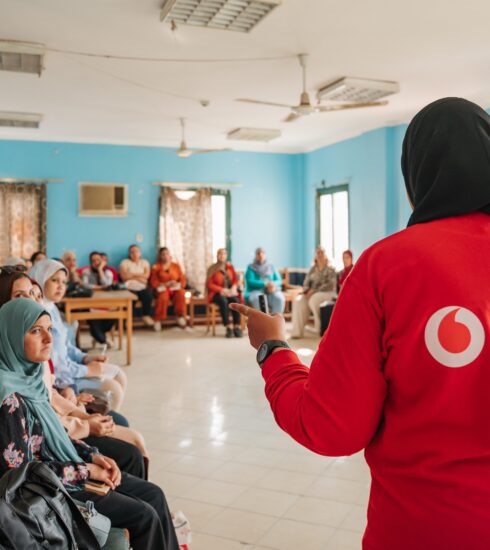
Working at Vodacom means being close to something that genuinely matters. Mobile technology keeps families connected, enables small businesses, and opens doors to education and opportunities in places that were once beyond reach.
As Ayman Essam, Vodacom Group Chief External Affairs Officer, puts it: “Life without mobile devices and access to the thousands of services available at the click of a button is simply unimaginable for most of us today.”
The power behind every connection
Calls, video streams, cloud services and AI-powered tools runs on vast infrastructure. Behind every message sent is a network of towers, data centres and digital systems that consume significant amounts of energy. Africa has between 250 000 and 300 000 mobile phone towers, with around 73 000 in South Africa alone, according to a Mordor Intelligence report. And with networks rapidly expanding, those numbers keep climbing.
Mobile technology is one of Africa’s greatest development tools. The challenge is keeping pace with growing demand for services that drive economic growth, improve social inclusion and create opportunity for the world’s youngest population – while also supporting the continent’s transition to a lower-carbon future. That means modernising networks, improving energy efficiency, investing in renewable power and collaborating across industries. It’s a big ask. But it’s exactly the kind of challenge we’re built for.
Facing the realities of climate change
Africa’s energy landscape is unlike any other. Electricity generation still relies heavily on non-renewable energy sources such as coal and diesel, with limited grid availability and power outages compounding the challenge. To keep networks running, operators depend on diesel generators as primary power as well as for backup. That means higher operating costs and more greenhouse gas emissions, not just from the fuel itself but from the logistics of moving thousands of litres to sites, many of which are remote.
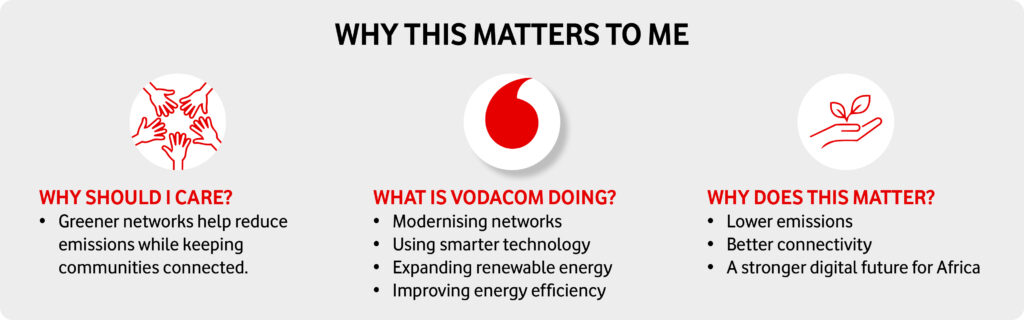
Addressing this, as explored in depth in our Decarbonising Africa’s ICT Sector report, requires a careful balancing act. As a purpose-led African connectivity, digital and financial services company, we’ve moved to support growth while facing the realities of climate change head-on.
Driving change through innovation and modernisation
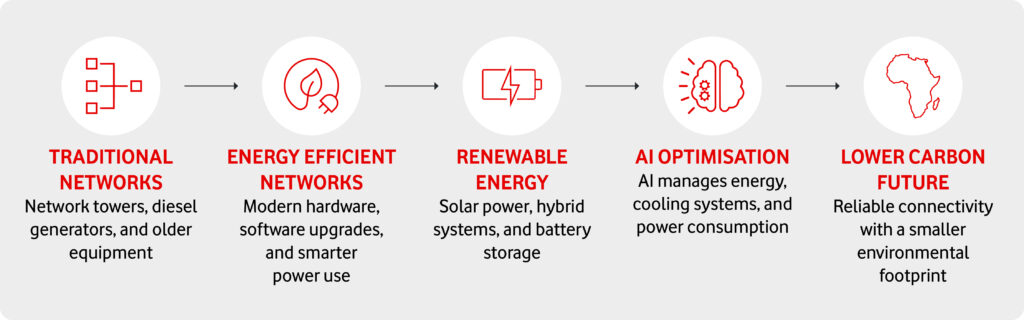
One of our most effective tools is network modernisation. By adopting more energy-efficient technologies, we can increase capacity while using less electricity across our sites. Smart monitoring and automation improve power management and let networks reduce consumption, without compromising the customer experience.
Automated, intelligent cooling systems, improved batteries, AI-driven energy optimisation and more energy-efficient data centres all contribute to lower overall energy demand.
Access to electricity remains a major challenge for around 600 million Africans. Mini-grids are one practical response. Designed for rural communities of more than 200 people who live near a road but more than 10 kilometres from the main grid, they allow fixed telecommunications base stations to connect mobile devices, transmit signals to the wider network and reduce the need for diesel generators. That means less diesel and emissions, and more connected communities.
How we are reducing our carbon footprint
Network modernisation: energy-efficient technologies that increase capacity while using less power, including upgraded cooling systems and more efficient data centres
Smarter software: data-rich, AI-driven energy optimisation and intelligent power management
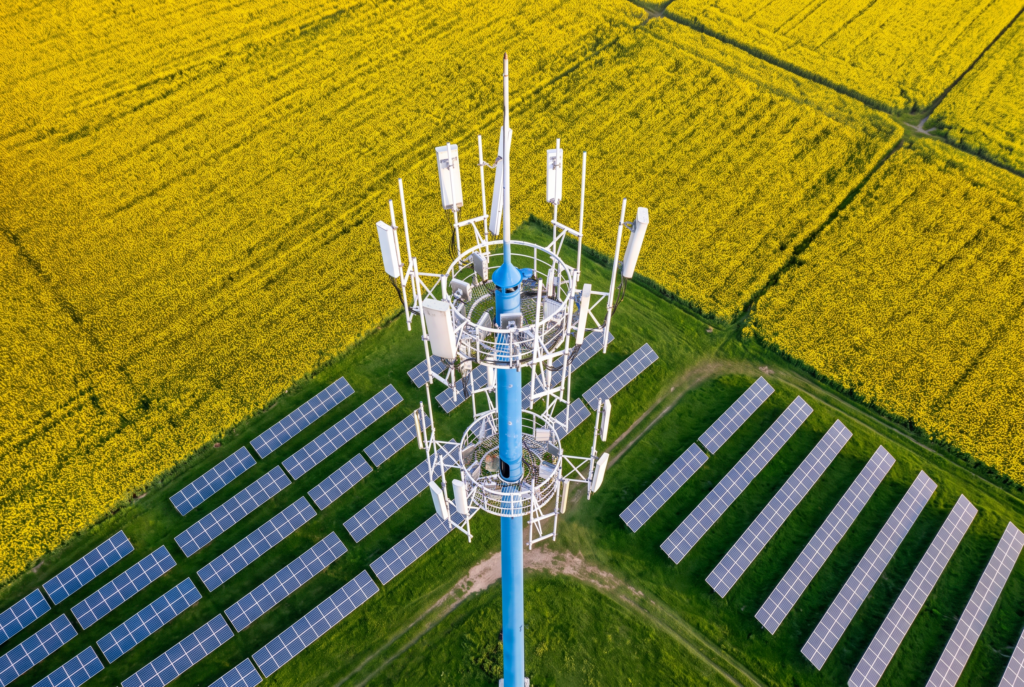
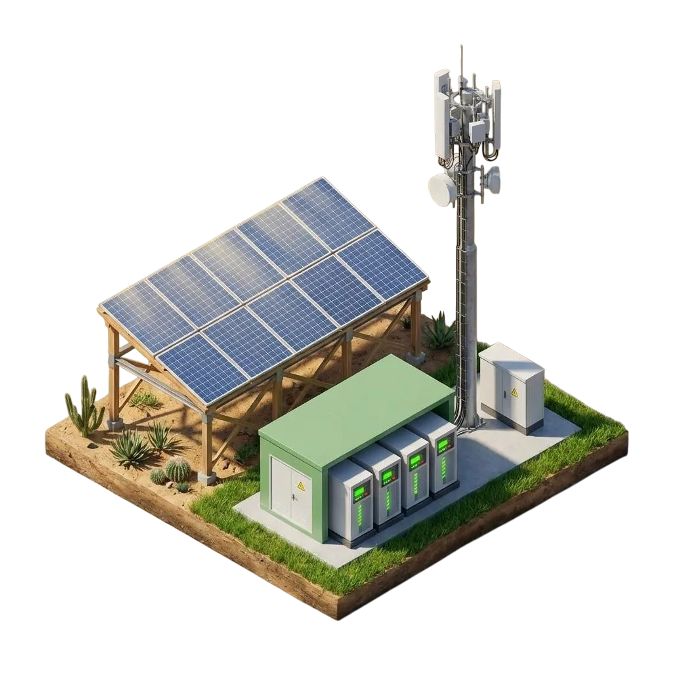
Renewables: power purchase agreements from renewable energy producers, on-site solar panels and hybrid energy systems with improved battery storage deployed at network sites
Innovation: piloting new technologies and constantly scanning for emerging ones
Harnessing Africa’s renewable energy potential
Africa has abundant sunshine, offering huge potential for solar energy. Hybrid energy systems, for example those combining solar and battery power, are already being assessed and deployed across our network sites. We already use hydro and wind power as well. As battery technology improves and the cost of renewables falls, more sites can operate with significantly lower carbon emissions.
For Vodacom, this goes beyond cutting costs. “It is an affirmation that we are part of a dynamic sector with a duty to help build the resilient digital infrastructure on which Africa’s prosperity will depend,” explains Ayman. “Every investment we make in energy-efficient networks, renewable power, and smarter technology contributes to our future while advancing our environmental goal to mitigate and minimise the negative impacts of our operations.”
By expanding digital connectivity across the private and public sectors, we also help customers use Vodacom solutions to increase efficiencies and reduce emissions in their own operations. With continued innovation, investment and collaboration, Africa’s digital future can be a lower-carbon future too.
• Help us reduce energy use. Switch off what is not needed, challenge wasteful habits, share ideas that could improve efficiency, and look for smarter ways to deliver the same great customer experience with less impact.
• Missed the first instalment in our Decarbonisation series? Read it here.
Bongi Mbuli, Group Executive Head: Internal Communications, Vodacom Group Sian Singh, Senior Specialist: Internal Communications, Vodacom Group Content contribution: Our thanks to the internal communications teams and representatives from the Vodacom Group of companies One Spirit is edited, designed and published on behalf of Vodacom Group by Media24 (Pty) Ltd
This communication is an internal magazine for employees of the Vodacom Group of companies that is intended solely for use by Vodacom Group employees and authorised representatives. Copyright 2026, Vodacom. All rights reserved. While all precautions have been taken to ensure accuracy of information, neither the editor, publisher nor Media24 can be held liable for any inaccuracies, injury or damage that might occur.
All content, information, artwork and opinions are Classified as C1, as per Cyber Security Restrictions.