Old phones, young minds: closing the loop on e-waste
A learner in KwaZulu-Natal turns plastic waste into herb pods. In a Vodacom store, a refurbished phone finds a second life. These are small acts, but they’re part of something much bigger. Welcome to the circular economy.
An old phone’s story isn’t over. Watch how Vodacom’s circular approach gives devices new life and creates opportunities for people.
The problem hiding in your drawer
There’s a good chance you have an old phone somewhere in your home, tucked into a drawer, sitting in a box, forgotten in a cupboard. You’re not alone. Globally, e-waste is one of the fastest-growing waste streams on the planet, and much of it never gets treated safely.
We are taking this problem seriously with a working circular economy model that turns old devices into jobs, refurbished phones and sustainability lessons for the next generation.
Five pillars, one loop
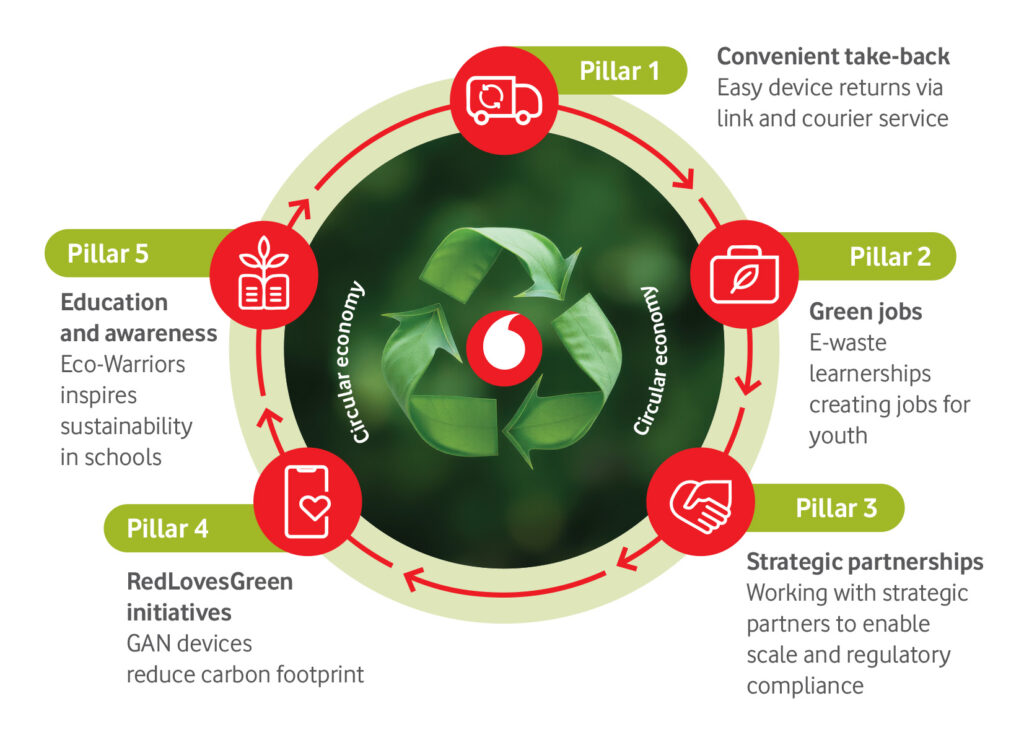
At the heart of our approach is a five-pillar circular economy strategy.
The first pillar is convenient take-back: in South Africa, customers can return old devices through any of the more than 500 Vodacom franchises or stores nationwide or book a home collection through Circular Energy’s dedicated scheme – a simple return that keeps devices out of landfill.
The second pillar is green jobs: our e-waste learnership programme equips South African youth with skills for the green economy, creating employment in recycling and refurbishment while building a sustainable workforce for the future.
The third pillar is partnership: we work with Circular Energy, certified recyclers and government bodies to make sure the model is compliant, scalable and genuinely impactful.
The fourth pillar, RedLovesGreen, focuses on reducing the carbon footprint of devices by extending their lifecycles. This is where the Advanced Repair Centre comes in, where returned devices are assessed, sorted and given a second life wherever possible:
267 000+ devices, weighing over 53 tonnes, processed
Nearly 20 000 reused or refurbished
±5 500 devices recycled
42% reduction in waste sent to landfill in the first half of FY26 vs. previous period
92% of general waste is now recyclable.
Devices that are certified for resale become part of the Good As New programme. These pre-owned smartphones are sold with a 12-month warranty and, in some cases, donated to Vodacom-supported schools.
51 000+ Good As New devices have been sold to date.
And the fifth pillar is the one that may matter most in the long run: education.
When learners become the solution
Big ideas start young. Meet Vodacom’s Eco-Warriors, turning everyday environmental challenges into practical solutions for their schools and communities.
Since October 2025, Grade 9 to 11 learners at 10 Vodacom Schools of Excellence across five provinces have been competing in the Eco-Warriors Sustainability Competition, designing and implementing real environmental solutions for their schools and communities.
The 2026 winners tell their own story:
St John Paul II Secondary School n Elandskop, KwaZulu-Natal, transformed plastic waste into reusable plant pods and established an eco-friendly vegetable garden.
Hlahlindlela High School, also in KZN, created a network of water ambassadors who monitor and report leaks through a digital platform.
Worcester Secondary School in the Western Cape turned waste materials into visual aids to teach waste separation, reuse and recycling.
These are practical, community-relevant responses to real problems: exactly the kind of thinking Vodacom’s purpose calls for.
Takalani Netshitenzhe
External Affairs Director for Vodacom South Africa
“Through initiatives like the Eco-Warriors Competition, we’re demonstrating that when you empower young people with connectivity and support, they don’t just see problems, but they also become the architects of solutions. These learners are proving that innovation knows no bounds, regardless of location or circumstance.”
These are practical, community-relevant responses to real problems: exactly the kind of thinking Vodacom’s purpose calls for.
Creating green jobs, not just good intentions
Beyond schools, our circular economy model is creating economic opportunity. E-waste learnerships are placing young people, with a specific focus on women, unemployed youth and people living with disabilities, into the growing recycling and refurbishment sector. It’s the kind of green job creation that aligns economic inclusion with environmental action – two things that too often get treated as separate conversations.
Meanwhile, at the network level, Vodacom Group redeployed R1.47 billion worth of network equipment in FY2026 rather than replacing it, keeping materials in use and costs in check at the same time.
Part of a bigger commitment
Our circular economy work sits within a broader environmental commitment that includes a target of net-zero greenhouse gas emissions (Scope 1 and 2) by FY2035. We’ve also participated in the global One Million Phones for the Planet campaign since 2022, working with Vodafone and other partners to keep devices in circulation and out of landfill.
From Cape to Cairo, the same Vodacom principle is gaining momentum: that a device given a second life, a learner who builds something from what others threw away, and a young person starting their first green job are all threads in the same story. Protecting the planet is one of Vision 2030’s core commitments, and it is being built practically, purposefully, one closed loop at a time.
• Read about Vodacom Congo’s Heroes of Zero Waste here.
Bongi Mbuli, Group Executive Head: Internal Communications, Vodacom Group Sian Singh, Senior Specialist: Internal Communications, Vodacom Group Content contribution: Our thanks to the internal communications teams and representatives from the Vodacom Group of companies One Spirit is edited, designed and published on behalf of Vodacom Group by Media24 (Pty) Ltd
This communication is an internal magazine for employees of the Vodacom Group of companies that is intended solely for use by Vodacom Group employees and authorised representatives. Copyright 2026, Vodacom. All rights reserved. While all precautions have been taken to ensure accuracy of information, neither the editor, publisher nor Media24 can be held liable for any inaccuracies, injury or damage that might occur.
All content, information, artwork and opinions are Classified as C1, as per Cyber Security Restrictions.