Mozambique is a country with huge momentum and real access challenges. The 5G spectrum milestone gives Vodacom Mozambique another tool to help connect more people, support growth and bring Vision 2030 to life locally.
Mozambique at a glance
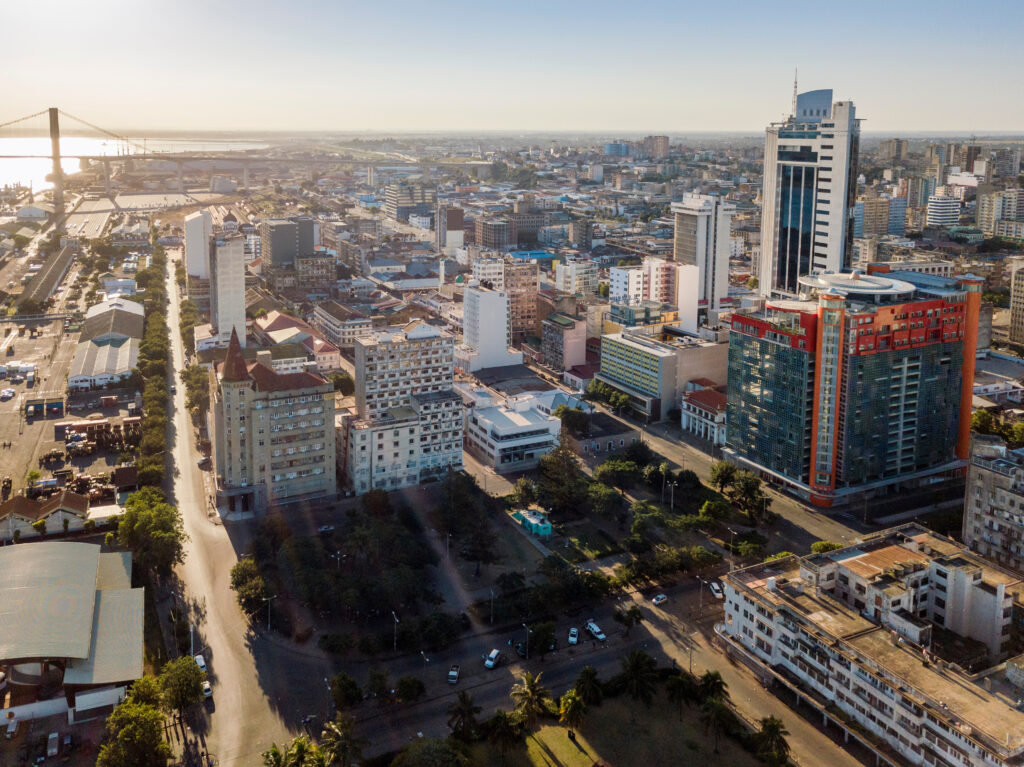
Mozambique is a market shaped by movement, scale and possibility. Its 2 740km coastline connects communities and commercial gateways such as Maputo, Beira and Nacala, while its economy is powered by sectors that depend on reliable connectivity, from agriculture and logistics to mining, energy and tourism. Vodacom has been part of this landscape since 2003 and today connects about 11.6 million customers across the country.
Together, these details tell a bigger story: Mozambique is a market of ambition and growth, but also one where geography, affordability and infrastructure shape how quickly digital inclusion can reach people.
A country moving forward
Mozambique’s story is often told through cyclones and communities rebuilding after difficult moments. But there is another story worth telling: entrepreneurs growing businesses, learners accessing education, connected communities and a digital economy gaining momentum.
Vodacom has been part of that story since 2003. In July 2026, Vodacom Group CEO Shameel Joosub met His Excellency President Daniel Chapo in Maputo to discuss a more connected, inclusive and digitally enabled Mozambique.
This ambition only becomes real when it reaches people. That depends on practical choices: which spectrum is available, how it is licensed, where networks are built first, and whether people can afford devices. That is where the story becomes technical and human.
A licence with national meaning
In Maputo, Mecúfi or a classroom far from the coast, a signal is only useful when people can reach it. Vodacom Mozambique’s 5G licence is a step towards turning valuable spectrum into everyday connection.
On 23 June 2026, Mozambique’s communications regulator, INCM, allocated 5G spectrum licences to the country’s three mobile operators: Vodacom Mozambique, Tmcel and Movitel. For Vodacom Mozambique, the award is more than permission to switch on a new generation of technology. It’s a practical route towards better capacity, wider digital access and stronger foundations for national growth.
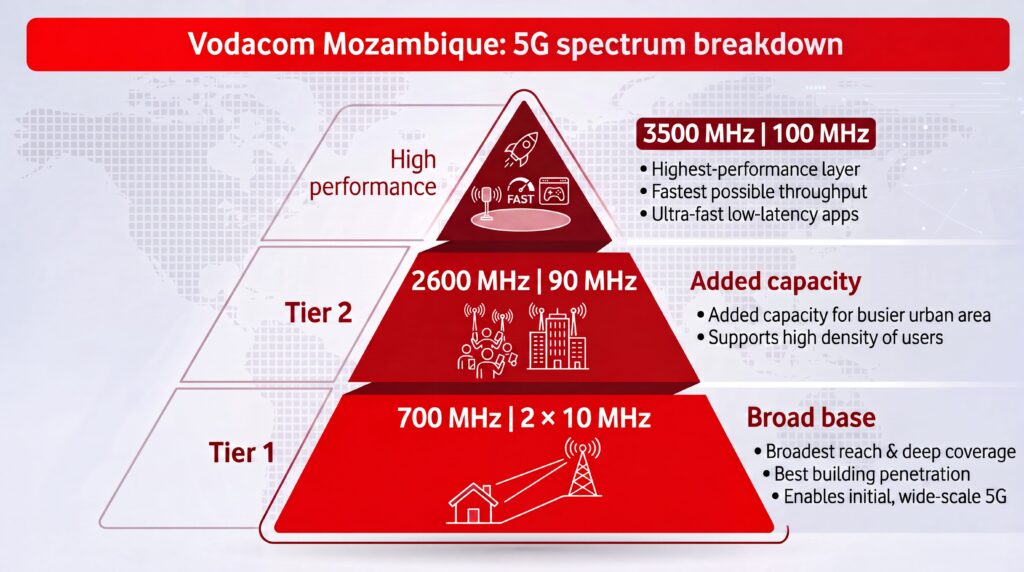
The licence gives Vodacom Mozambique access to a mix of low, mid and high-frequency bands: 2 × 10 MHz in the 700 MHz band, 90 MHz in the 2600 MHz band and 100 MHz in the 3500 MHz band. In simple terms, these numbers represent the frequencies that will make coverage travel further. Some add capacity in busy areas, and others support faster, high-performance services.
Spectrum, without the jargon
Shergen Padayachee, EHOD: Technical and Wholesale Regulation at Vodacom Group, says the simplest way to understand spectrum is to think in layers. Lower frequencies travel further; higher frequencies carry broader chunks.
Shergen compares Mozambique’s spectrum to a cake: 700 at the bottom, 2600 in the middle and 3500 at the top. “They all work as layers on top of each other,” he says. “You need a combination of all of this to build a proper 5G network.”
Complementary generations, practical choices
5G is an important milestone, but it does not mean leaving 4G behind. The two generations work together: 4G remains essential for broad mobile broadband and everyday access, while 5G adds capacity, speed and new possibilities in places where demand, devices and use cases are ready.
That is why regulation matters. Regulators decide which bands are made available, how they are licensed, what fees apply, and what coverage or quality obligations come with them. Those choices influence where operators can invest first, how quickly networks can be built, and how well different generations of technology can support customers together.
For Vodacom Mozambique, progress will be a careful sequence. 5G can relieve pressure on 4G in congested areas and improve the experience for customers with compatible devices, while 4G continues to carry many customers who rely on it today. As Shergen puts it: “It makes no sense to roll out 5G in a place that is going to take five years for users to use a service. Then you stay with 4G.”
The device question
One of the biggest barriers to meaningful 5G adoption is whether people can afford the devices that make the network usable. Shergen explains: “The major challenge is device affordability. How do we actually get sufficient people to get a device?”
Mozambique’s national digital inclusion plan features a subsidised smartphone programme targeting over 710 000 devices as part of the country’s broader 5G and 4G roll-out strategy. Operators, government, regulators and manufacturers all have a role to play, from subsidies and financing to tax decisions, procurement scale and practical specifications that meet real customer needs.
When the pieces come together, better connectivity can enable telemedicine, remote education, agricultural solutions, enterprise services and everyday network quality. But until people can access the right devices, the full promise of 5G remains out of reach.
Vision 2030, made local
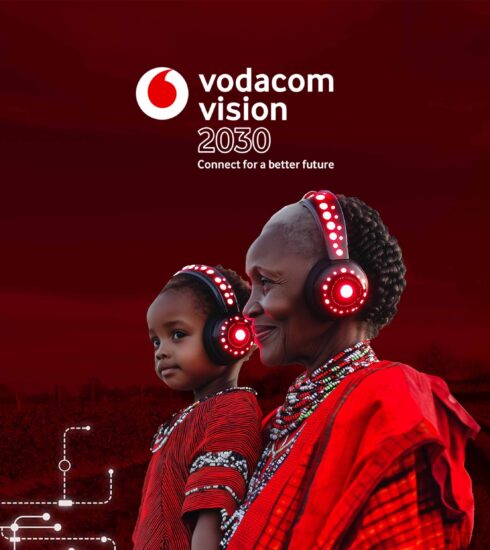
Vision 2030 is about becoming Africa’s leading technology communications company in ways that are inclusive, trusted and useful. Vodacom Mozambique’s 5G licence brings that ambition into a market with immense potential, infrastructure challenges and millions of customers who need reliable digital access.
The next signal will be planned band by band, site by site and community by community. That is how spectrum becomes human: a lesson online, a clinic connected, a business growing, and a country moving further together.
Read more about the vital role regulation plays in our industry here.
Bongi Mbuli, Group Executive Head: Internal Communications, Vodacom Group Sian Singh, Senior Specialist: Internal Communications, Vodacom Group Content contribution: Our thanks to the internal communications teams and representatives from the Vodacom Group of companies One Spirit is edited, designed and published on behalf of Vodacom Group by Media24 (Pty) Ltd
CREDITS
Cover image: Getty Images & Adobe Firefly Photographs, videos and illustrations: Supplied by Vodacom Group, Adobe Stock, Adobe Firefly, Gallo Images, Getty Images & Google Gemini
DISCLAIMER
This communication is an internal magazine for employees of the Vodacom Group of companies that is intended solely for use by Vodacom Group employees and authorised representatives. Copyright 2026, Vodacom. All rights reserved. While all precautions have been taken to ensure accuracy of information, neither the editor, publisher nor Media24 can be held liable for any inaccuracies, injury or damage that might occur.
All content, information, artwork and opinions are Classified as C1, as per Cyber Security Restrictions.