When the internet goes dark: five questions that guide us
As a responsible network operator, Vodacom operates under the licensing agreements, laws and regulatory frameworks of different countries. We also serve people who rely on connectivity to learn, work, trade, reach family, access financial services and, sometimes, call for help.
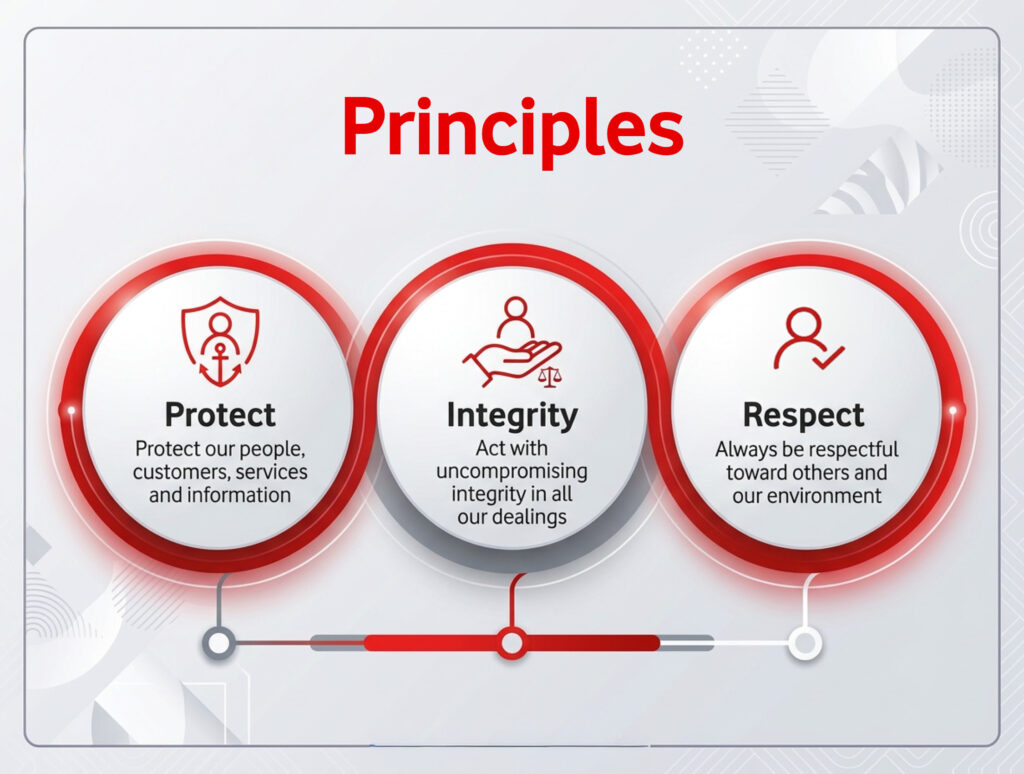
Our Code of Conduct gives us a practical way to pause under pressure. Built on the principles of Protect, Integrity and Respect, it asks five questions that help turn a high-stakes situation into a disciplined decision-making process that considers the legal requirements and societal needs through an ethical lens.
The debate over internet shutdowns has grown as societies become more dependent on digital platforms for connectivity and for access to information. For Vodacom, this reinforces the importance of maintaining trust: connecting more people to opportunity while acting responsibly when connectivity itself is under pressure. Receiving a request to shut down the internet from a government agency or regulatory body happens in a moment of pressure, when public safety, legal duty and people’s need to stay connected all demand an answer at once.
This type of request sits at the intersection of law, public safety, human rights, employee safety and trust. The question isn’t only whether we can comply, but how we decide, who is involved and whether the response is lawful, necessary and proportionate.
It is exactly this nuanced situation where our Code of Conduct comes into play. Following the five decision-making questions is what guides us towards a responsible outcome.
1. Is it legal?
The first step is to establish exactly what has been requested, by whom and under which legal authority. Some countries have explicit laws governing internet traffic and network restrictions. In these instances, when an explicit request is received, compliance may not be optional, but this does not remove the need for scrutiny. The source must be verified, the scope, duration and legal basis must be understood, and additional clarification may be needed.
When a request is made for an internet shutdown, it is usually in a time of strife, such as political unrest or another crisis, making access to the usual stakeholders and resources challenging. That’s why even without explicit laws, it is imperative that we are prepared for such a crisis. Clear escalation procedures, relationships with regulators and documented frameworks help prevent rushed, one-person decisions. Legal, regulatory, risk, security, public policy and executive teams all have a role to play long before a request may be received.
Three words to remember
Legal: Is there a valid basis in law?
Necessary: Is the restriction needed to address a specific risk?
Proportionate: Is it the least intrusive option available?
2. Would this be damaging if it went public?
A decision may be lawful and still carry serious consequences. Connectivity has become a part of daily life: a student downloading notes, a trader receiving mobile money, a family checking on loved ones, a clinic reaching emergency support.
The public test asks us to look beyond the instruction and consider the impact. Would essential services be disrupted? Could customers lose access to financial services, health services, education or critical information? Could employees be put at risk during unrest? Could a broad restriction affect people beyond the source of the threat?
Vodafone’s transparency reporting states that indiscriminate shutdowns and mass blocking can limit freedom of expression and access to essential services. That is why each request must be assessed carefully, and why transparency around the legal basis, rationale, scope and duration matters wherever the law allows.
3. Is this decision in line with our Code and policies?
Apart from applying internal policies, human rights due diligence and governance processes consistently, this step points us back to our common principles:
A shutdown request should be interpreted and implemented as narrowly as the law permits. If a request appears overly broad, disproportionate or unclear, the response may be to seek clarification or propose a less intrusive alternative, provided it is safe and lawful. This could mean exploring a less intrusive alternative to a blanket one, where a volatile location is targeted, a shorter timeframe is proposed, or a specific platform is disabled temporarily to neutralise possible threats.
The aim is not to obstruct regulators, but to work with them responsibly, so that any response is tied to the specific risk.
4. Would I feel comfortable explaining my decision to family or friends?
This question asks whether you would be comfortable explaining and defending your decision to others. Could you clearly articulate why the decision was necessary, how it aligns with legal and business requirements, and how the potential impact on people was considered? In a volatile situation, one has to take a balanced approach by weighing up the risks to find the least harmful option. This leads directly to the final question.
5. Is it ethical?
The ethical question is the final test, and often the hardest. It recognises that legal compliance and human impact must be considered together. A decision can be urgent without being careless. It can respect the authority of the state while still asking whether the measure is targeted, time-bound and defensible.
Making responsible decisions
When the internet goes dark, the decision behind it should never be made in the dark. It should be guided by law, tested against our policies and Code of Conduct, shaped by respect for human rights and made through the right expertise. That is how we balance our obligations with our purpose: connecting for a better future.
The final message is that you are not alone. If something feels unclear, rushed or wrong, please contact your local Ethics and Compliance team. For more information, visit the DWR site and watch the webinar to hear the human, legal and ethical questions behind internet shutdowns.
Bongi Mbuli, Group Executive Head: Internal Communications, Vodacom Group Sian Singh, Senior Specialist: Internal Communications, Vodacom Group Content contribution: Our thanks to the internal communications teams and representatives from the Vodacom Group of companies One Spirit is edited, designed and published on behalf of Vodacom Group by Media24 (Pty) Ltd
CREDITS
Cover image: Getty Images & Adobe Firefly Photographs, videos and illustrations: Supplied by Vodacom Group, Adobe Stock, Adobe Firefly, Gallo Images, Getty Images & Google Gemini
DISCLAIMER
This communication is an internal magazine for employees of the Vodacom Group of companies that is intended solely for use by Vodacom Group employees and authorised representatives. Copyright 2026, Vodacom. All rights reserved. While all precautions have been taken to ensure accuracy of information, neither the editor, publisher nor Media24 can be held liable for any inaccuracies, injury or damage that might occur.
All content, information, artwork and opinions are Classified as C1, as per Cyber Security Restrictions.