Empowered to learn
As we mark Vodacom’s 30th anniversary and our award as the number 1 Top Employer in Africa, we chat to two employees from different generations to highlight how our core behaviour of “Experiment, learn fast” has been part of the Group’s DNA from the very beginning, driving our innovation and growth over the decades and into the future.
A company of trailblazers
“In the beginning, there was no SMS,” Johan says about Vodacom’s earliest days.
“You couldn’t send an SMS to anyone. You could receive a text – but only to notify you of voicemail. Voicemail in 1994 was a big thing, because in those days not many people had telephone answering machines.
“Before that,” Johan says, “in late ’92, early ’93, we started getting involved with this mobile phone thing and GSM. At the 1993 annual conference of Telkom, which owned 50% of Vodacom at the time, we demonstrated GSM, a working phone with a base station in Cape Town.”
Over the years, there were countless examples of Vodacom’s spirit of thinking big and breaking new ground. One example is when it was decided Vodacom needed to provide coverage on the N1, the South African national highway, by the end of 1994 – in our first year of operation.
“Yes, it was pretty early,” Johan says. “People thought we were crazy, but I think we got an advantage over the competition that we still have.”
In Phindi’s case, three close friends inspired her to break with traditional expectations of a young woman from a township. “Compared to other young people where I came from, my friends went in a completely different direction that I didn’t expect – science and IT,” she says.
“I thought, well, this is interesting. This means that I can also branch out. Just seeing how motivated they are in those fields and everything they’ve done so far at a young age… I decided I also want to be part of that movement.
“We’re trying to be role models for the next generation, showing them that there’s a different world out there, especially with science, technology, engineering and maths (STEM).”
Learning fast, on the job
Vodacom’s ethos of experimenting and learning fast has been there from the start. Before launching, the company needed to build a network operations centre in Cape Town, Johan says.
Being from Cape Town, Johan was keen to volunteer for the job. Admittedly, it was a role he was unfamiliar with – but fortunately he was a fast learner, and he found himself in the role in Cape Town two weeks later.
“It was as simple as that. Decision made instantaneously,” he says.
“We had nothing. I didn’t quite know what I was doing,” Johan says about that steep learning curve. “We were almost playing it by feel.”
They successfully established the network operations centre, which Johan ran at the time. “Today, it’s the Africa network operations centre.”
Phindi knows all about being in the deep end. “When I first took up this communications role,” she says, “they threw me in, and I had to swim with the sharks! From the first week, the message was: we are not going to babysit you. I’ve been here for about two years, and from the first day, my managers made it clear that this is an on-the-job learning role. You just need to keep up the pace.”
Vodacom encourages a culture of learning and development, especially learning from people within the organisation, she adds. “For me, it’s important to also have a mentor in your business department.
“Luckily, I had a mentor, Thato Leokaoke, our Group Internal Communication Specialist – or I decided that she was my mentor! She’s been wonderful in teaching me from day one.
“Thato was very firm, saying, ‘I’m going to tell you this and I’m only going to tell you once. And if you don’t get it right, then that’s on you.’ So she’s been very instrumental in just helping me adapt and learn fast in this role,” Phindi says.
A culture of learning and teaching
Johan has a clear preference for how to learn and to teach effectively. “I am also a big believer in talking to people, parting with the knowledge, educating people,” he says.
“I’ve seen many youngsters come into the organisation over many years, they’ve just finished their studies, they’re all raring to go, but they don’t know anything about life, actually. You try and part with some of that knowledge through conversations.”
At Vodacom, there’s an expectation that experienced employees should guide the team to try and get them to the same level, to be sure that you don’t lose that knowledge. “You need to look after your people, and Vodacom does that,” Johan says. “You need to nurture this inside the organisation.
“There are still some things that I believe I need to do,” he adds. “The headspace I’m in at the moment is around teaching, guiding, helping the next generation.”
Phindi’s headspace is very much about learning. She has learnt to embrace being a student – “to surround myself with people who are smarter than me”.
“How else are you going to learn if you don’t learn from them? That’s how I’ve learnt and grown.”
This mindset is integral to Phindi’s job, where she works closely with the Learning and Development team. “Our role is to help employees learn and grow, to make sure they stay informed and engaged on all the relevant information about any learning and development opportunities,” she says.
“For example, we have the Grow My Impact platform. Anything that has to do with performance and development, if there are any updates, we make sure that we send it out timeously, we make sure that people register, we give them updates, we give them reminders.”
Out-of-office lessons
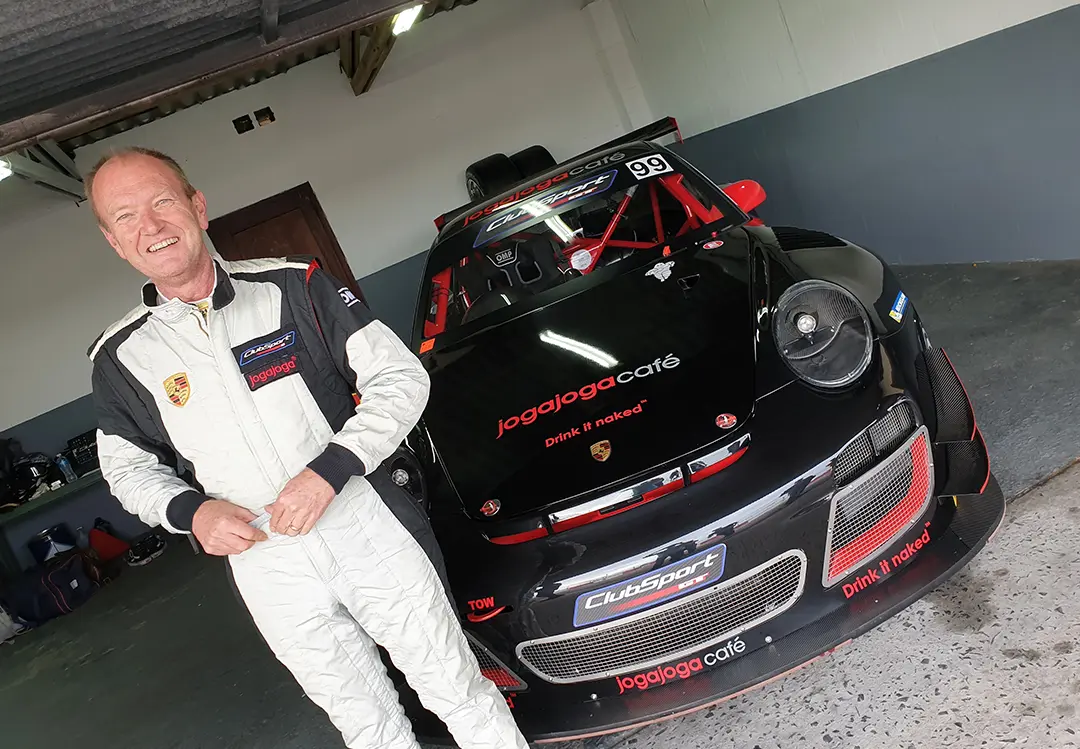
After racking up significant wins in real-world motor racing for years, Johan recently shifted gears to the lower-risk world of online racing, a continuation of his love for racing as a competitive hobby.
“Online racing is a whole different culture where you get to engage with people globally that you don’t know,” he says.” You don’t know whether they’re 80 or 16.” Whether it’s on the real track or online, “it’s a complete switch-off from everything around you”.
“To an extent, it’s a way to get away from work, but it can also be a way to think about work. Because when you’re in that car, or even with an online game, it’s quite intense. You think about one thing. You’re absolutely focused on this one thing and this one thing is to keep this damn car on the track and not to go off the track.”
Just like in motorsport, health and safety is critical at Vodacom, he explains. “To be able to do things the right way. To not die. To not do stupid things. When you work at heights, to do it properly. And always expect the unexpected.”
Johan recalls an incident on the track that drove home this message. “I was racing in Cape Town, and the car in front of me blew its engine. Something went wrong. It was a big cloud of smoke. And I was sitting there thinking, okay, what’s going to happen now? Then the car’s wheel came off and came flying past. But I was waiting for something to happen. I was expecting the unexpected.”
Phindi has also found lessons that cross her work and home life: making the most of her available time. Although she’s learnt to take it slow at home, usually being engrossed in a book, she isn’t one to rest on her laurels. The key is time management.
She makes time to develop a skincare range with a lab, and she loves trying new foods at restaurants. Another passion is going to concerts – and Phindi’s love for live music motivates her to be a master of time management, setting clear boundaries at work and at home.
“I think because I love going out to concerts, I’ve learnt to prioritise and manage my time, which helps me in my work,” she says. “It means I can do a lot of things within an hour.
“When I’m off from work, I can jam-pack anything that I want to do in just three hours. It helps my productivity in general because I can work fast.”

Keeping pace with tech
Working at a dynamic technology company, the learning is never done.
“These days, I’m interested in learning more about tech, especially now, because I was introduced to Robotics Process Automation (RPA) and all the innovation that comes from there,” says Phindi. “I’m slowly falling in love with everything that’s tech! It’s hard not to when you’re in a TechCo environment.”
The RPA initiative invites all employees to invent a bot that will help to automate processes and take us closer to achieving our TechCo ambitions.
There’s something new happening every day, Phindi adds. “We’re always trying to break boundaries. It’s about being curious and trying as many things as possible, whether they work out or not. We’re in an environment where we’re allowed to fail the first time. I’m allowed to try things and to explore.
“Tech is the future. It’s a learning experiment – to learn fast.”
Having been on a learning journey at Vodacom for 30 years, Johan says that although one shouldn’t dwell in the past too much, you do need to understand where you come from. “Look at where you want to go to and where you’re going to in the future,” he adds.
“It is a progression with technology, and one of the main things is to make the technology more efficient. That’s the key driver. For example, if you look at spectrum, it’s finite, so you need to use that as efficiently as possible. And if you look at how the technology has changed from 2G, 3G, 4G into 5G, that’s exactly what’s happened. That’s why you get the faster speeds.
“Using the same spectrum, it is a lot more efficient, so you can carry more traffic. 5G gives you more data and faster data. We actually have not yet really explored the other use cases of 5G. For example, with 5G, the technology has a much lower latency than 4G. And once you talk low latency, you can now start talking about things such as autonomous vehicles, and in the medical field, remote operations.”
Growing more efficient
Improving efficiency is exactly what Phindi wants to achieve with her RPA project. “My robotics idea has to do with tag lists – essentially a distribution list for our emailers,” she explains. “They are very time-consuming because they have to be targeted.
“If, say, I want to send out a mailer to youth, then I have to create a separate distribution list. Or if I want to send it to women or people in a certain region. My idea is to build a bot to create these lists for me, because it’s time that I could use on something else.”
Another way tech can improve efficiency is with AI, and generative AI in particular, Phindi says, including in the Learning and Development space. “AI can personalise by analysing individual preferences. It can help in offering targeted training programmes for employees, tailoring it to what they can improve.
“We’ve had training on how to use ChatGPT at Vodacom. Because my work includes writing, crafting comms, I use ChatGPT and I find it very, very useful. It’s still a work in progress but the base is there. So, that’s what I love about ChatGPT. It has helped me humongously when it comes to writing.
“Of course, I still need to tailor the message at the end of the day. You have to keep certain things in mind for safety, for example, that it’s not confidential information.
“I’m excited to see what more they can do with it. Like, come on, let’s push it, you know? Let’s get there. I think in every area across Vodacom, AI is going to play an important role.”
Learning to connect our markets
When working across multiple countries, multiple cultures and different cultures, the trick is not to try and force or enforce commonality, Johan says. “You need to truly understand how that culture, that market, operates, how the people operate, because it’s a people thing.”
With technology, it’s the same thing in every market: a phone is a phone, a base station is a base station. “But it’s really about the cultures, the people – trying to find that golden thread that makes people tick and getting them together.”
Johan has always found it interesting to go into the markets and engage with the people socially, to get to understand them.
“One of the key moments, something that I’ll always remember, was in Lesotho,” he says. “There’s a big hill in the middle of Maseru. One late afternoon I took the technology community out there for dinner, and after dinner we went up this mountain and sat there, lit a fire and sat around the fire and talked and looked at the Maseru skyline.
“It’s those things that I’ll remember forever. In that way you begin to understand the people, and that can pull them together as one team and One Vodacom.”