Beyond bots: how Intelligent Automation adds business value
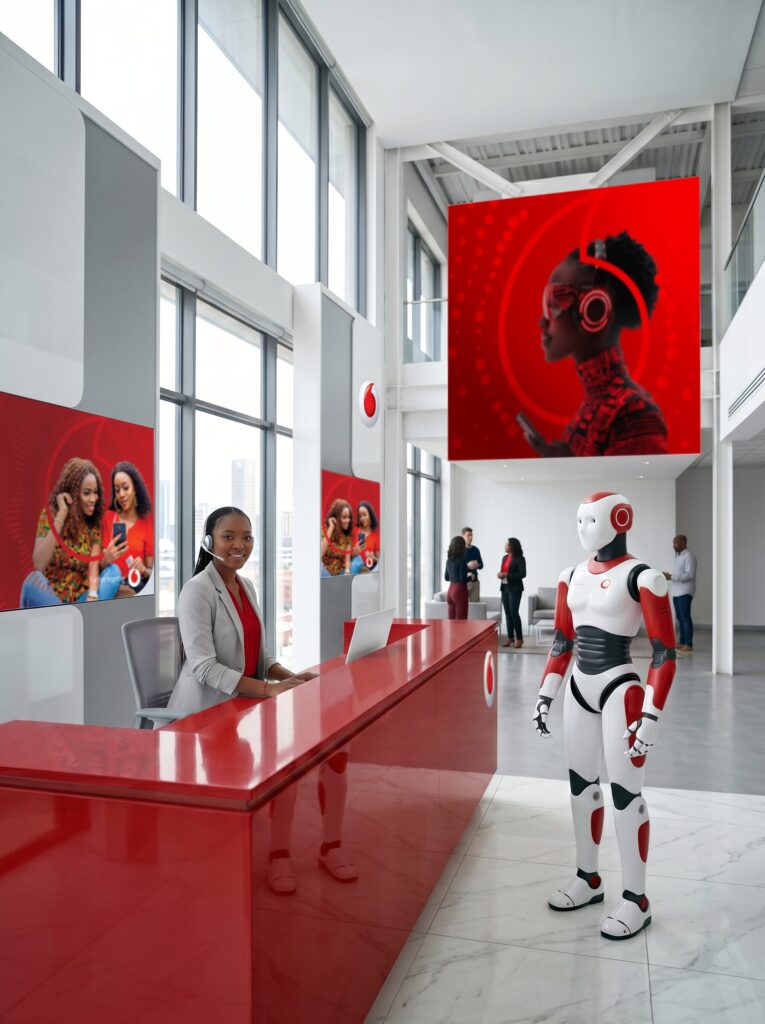
A customer asks to leave Vodacom. Before an agent responds, automation gathers context, AI reads the intent, and a person still makes the call that matters. That’s Intelligent Automation at work: faster service, sharper decisions and better outcomes.
Inside Vodacom’s Intelligent Automation team, the work starts with a business problem, not a tool. Ati Ngubevana, EHOD for Intelligent Automation, Kamva Motsabi, Chapter Lead: Intelligent Automation, and Kamogelo Mudzanani, Intelligent Automation Architect Lead, sit at the point where process, technology and human judgement meet.
Their focus is practical: help Vodacom work smarter, reduce repetitive effort, improve customer and employee experiences, and make sure automation is applied where it can create value. The capability has evolved from Robotic Process Automation (RPA), which handles structured, repeatable tasks, into a broader Intelligent Automation practice that brings together RPA, machine learning, Generative AI, process engineering, business analysis, governance and human oversight.
‘What are we trying to solve?’
In simple terms, Intelligent Automation helps Vodacom move from automating isolated tasks to improving complex end-to-end work. It also changes the conversation with the business. As Kamogelo puts it, “We started asking, what problems are we actually trying to solve?”
This question is crucial, because the team often bridges subject matter experts and technical specialists. Business teams understand the pain points and the process. Technical teams understand what can be built. Intelligent Automation helps translate between the two.
“We try to understand the full end-to-end value chain,” says Kamogelo. That includes asking whether “the process itself requires re-engineering before we can introduce technologies”.
Fix the process before you automate it
Kamva says the discipline is essential. “You could automate stupidity, but honestly, what is that going to do for you?”
It’s a sharp line, but the point is constructive. If a process is broken, outdated or unnecessary, automation can make the wrong thing happen faster. Process engineering helps Vodacom decide whether the work should be redesigned, simplified, stopped or automated.
That is where value is protected. The team isn’t there to build automation for its own sake. It helps identify what we are trying to achieve, what outcome matters, and which solution will deliver responsibly and at scale.
What this looks like in practice
One of the clearest examples is customer retention. Ati describes a use case where customers send Vodacom a request saying they want to leave. Instead of leaving a customer care agent to search across systems while the customer waits, automation brings relevant information together before the conversation reaches a critical point.
“We’ve got what we call a human in the loop,” says Ati, with automation “bringing as much information as we can” in front of the agent. The person still intervenes, makes the judgement and engages the customer. If the customer accepts the offer, automation can complete the remaining back-office work.
The outcome is better for the customer, better for the agent and better for the business. Ati says that by combining “AI and machine learning and RPA, together with the human”, the team has helped agents retain more customers and deliver tangible financial benefit to Vodacom.
Automation in action
From customer request to resolution: Many customer requests arrive as emails, chatbot messages or notes in customer management systems, written in everyday language that may be incomplete, informal or non-standard.
With Gen AI, the team can interpret what the customer is trying to do, classify the request and translate it into structured information – for example, what the customer needs, which account or service it relates to, how urgent it is and what action is required.
That structured request can then be passed to the appropriate department to complete the next step. Ati says this “converged use of these technologies” has “amplified the kind of automations that we can implement”.
Building confidence through learning and development
Technology only creates value when people understand it, trust it and know how to use it in their daily work. Upskilling is one of the most important levers for adoption. Ati believes if we can get colleagues to first understand the technology, then they can see where the opportunities lie.
That thinking sits behind Citizen Development, Data Science Citizen and AI Citizen initiatives. Ati says the original agenda was to “democratise skills” by taking practical capability to “the people that actually do the work”. The idea is not that every colleague must become a software engineer. Employees know their own processes best, which makes them best placed to spot opportunities for digitisation and automation, build confidence and help shape solutions that work in practice.
Kamva says the citizen programme helps non-technical specialists build the skills to take on automation or AI-driven solutions themselves. That empowers each of us at Vodacom to shape change, rather than watching it happen from the outside – and it helps reduce automation anxiety along the way.
Kamogelo makes the human point clearly: teams need to be taken along the journey so they understand “the empowerment that will come as a result of the implementation as opposed to the replacement”. Automation can remove lower-impact manual work and create space for judgement, problem-solving, service and improvement.
Balancing efficiency with experience
The team’s approach is deliberately human-centred. Intelligent Automation may use advanced technologies, but accountability still matters. “There will always be a need for an element of human touch,” says Ati, because “somebody must still be held accountable for the decisions”.
That is especially important as the technology evolves. Agentic AI, where systems can plan and act with more autonomy, is a future-facing area the team is watching carefully.
Kamogelo sees the opportunity: “Autonomous agents will give us the ability to scale judgement and not just efficiency.”
Have an automation opportunity in mind?
Start with the business problem, not the bot. If there’s a process that takes too much time, creates friction for customers or keeps your team from higher-value work, it may be worth exploring. Visit the RPA SharePoint site to learn how to engage the Intelligent Automation team, explore citizen development resources and take the next step.
Bongi Mbuli, Group Executive Head: Internal Communications, Vodacom Group Sian Singh, Senior Specialist: Internal Communications, Vodacom Group Content contribution: Our thanks to the internal communications teams and representatives from the Vodacom Group of companies One Spirit is edited, designed and published on behalf of Vodacom Group by Media24 (Pty) Ltd
This communication is an internal magazine for employees of the Vodacom Group of companies that is intended solely for use by Vodacom Group employees and authorised representatives. Copyright 2026, Vodacom. All rights reserved. While all precautions have been taken to ensure accuracy of information, neither the editor, publisher nor Media24 can be held liable for any inaccuracies, injury or damage that might occur.
All content, information, artwork and opinions are Classified as C1, as per Cyber Security Restrictions.