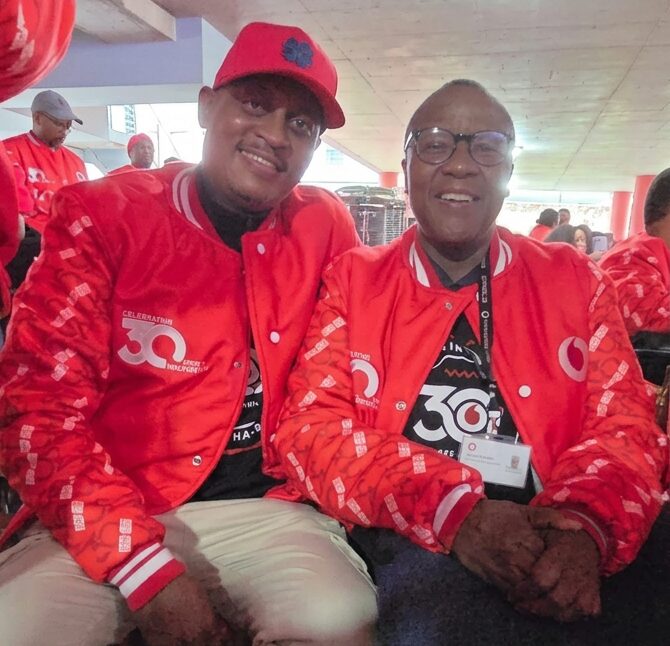
Where mountains connect: 30 years of Vodacom Lesotho
When Vodacom Lesotho switched on its first portable base station in 1996, mobile connectivity was still a rumour for many Basotho. Thirty years later, it’s part of how a nation learns, trades and stays close.
The kingdom above the clouds
To understand why connectivity matters in Lesotho, start with the land itself.
Lesotho is the Mountain Kingdom: a country of highlands, plateaus, valleys and sharp horizons, entirely surrounded by South Africa but unmistakably its own. Its highest point, Thabana Ntlenyana, meaning “beautiful little mountain”, rises to 3 482 metres. In many places, life is shaped by altitude, distance and weather as much as by roads or borders.
That geography gives Lesotho its character. It’s a country where the Basotho blanket is both practical and deeply symbolic; where the mokorotlo hat carries national identity; where villages, farms and trading towns sit against some of the most dramatic landscapes in Southern Africa. It’s also a place of movement and growth: people travelling between districts, families staying connected across vast distances, entrepreneurs seeking customers, learners seeking knowledge, and communities relying on connectivity for services when terrain makes access more difficult.
Two Lesotho milestones, one story of connection
High in the Maloti Mountains, the Katse Dam stands as one of Lesotho’s most recognisable feats of ambition. Built as part of the Lesotho Highlands Water Project, it changed how the country’s water, energy and engineering potential were understood – not only as national assets, but as bridges to regional progress.
The Katse Dam’s 30th anniversary lands alongside Vodacom Lesotho’s own 30-year milestone, creating a powerful parallel. One connects communities through water and infrastructure; the other through connectivity, digital services and financial inclusion. Together, they tell a bigger story about Lesotho’s ability to build for the long term.
A mix of heritage and ambition
The country’s economy reflects that same mix of heritage and ambition. Lesotho is known for water, diamonds, wool and mohair, textiles, agriculture, tourism and handicrafts. Its rivers and mountain systems are national assets. Its culture is rooted in Sesotho language, Basotho pride and a history of independence dating back to 4 October 1966.
For a network, this is not easy terrain. Coverage has to climb mountains, cross valleys and serve communities that aren’t always close to the centre. In a country with a population of about 2.4 million, that makes Vodacom Lesotho’s 421 sites more than infrastructure. They’re part of how a highland country becomes more connected without losing what makes it distinct.
In Lesotho, connectivity arrives on a mountain road, in a classroom, at a market stall, in a clinic, on a family phone. It helps a small business trade beyond its immediate surroundings. It helps young people reach information that once felt far away. It helps a country known for height and distance feel closer to itself.
30 years of milestones
1996: Vodacom Lesotho’s launch year, initially as Vital Communications Link (VCL)
421 sites: the network footprint built over three decades
1.7 million: customers in Lesotho
300+ colleagues: permanent, temporary and contract employees contributing to the journey
Population reach today
98%
Basotho with access to the internet
68%
A birthday built around people
Seen against that landscape, Vodacom Lesotho’s 30th anniversary is not being treated as a date on a calendar. It’s being built as a year of recognition: for the customers who trusted a new network, the partners and institutions who helped it grow, and the colleagues who turned a first signal into a national platform.
The numbers tell one part of the story. From that first portable base station, Vodacom Lesotho has grown to 421 sites, reaching around 98% of the population and opening the door to internet access for roughly 68% of Basotho. But the more important measure is harder to capture: the call that gets help to a home, the message that keeps a family together, the data bundle that helps a learner study, the payment that keeps a small business moving.
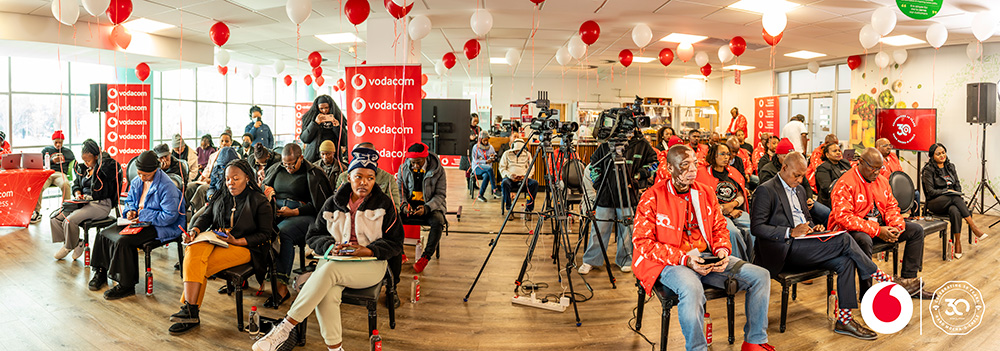
That is why the anniversary launch began with gratitude. The public announcement in Maseru recognised the government of Lesotho, the regulator, customers, partners and employees who have carried the journey since 1996, when the company was first known as Vital Communications Link (VCL). As Tšepo Ntaopane, EHOD for External Affairs and Regulatory at Vodacom Lesotho, said: “Today Vodacom Lesotho celebrates 30 years of connecting Basotho for a better future.”
'Matumelo Qaba celebrates Vodacom Lesotho’s 30th anniversary with Tšepo Ntaopane, EHOD for External Affairs and Regulatory. 'M'e 'Matumelo was one of the company’s first employees, with an employment letter dated 1 January 1996.
From first signal to everyday infrastructure
Thirty years ago, a mobile signal was still something many people had only heard about. Today, connectivity sits at the centre of national development. It supports learning, work, trade, healthcare and public services. It gives families more ways to communicate and entrepreneurs more ways to be seen, paid and trusted.
This is also the story Vodacom Lesotho is telling through the anniversary: a living record of how communication changed daily life across the Mountain Kingdom. That matters because some of the early records are incomplete. Photographs, documents and detailed recollections aren’t always easy to find. But the gap has created a more human story: one reconstructed through people, not only through files. The anniversary is becoming a chance to preserve institutional memory and show newer colleagues that they are part of something with deep roots.
Celebrating from the inside out
Behind every site that helps stitch Lesotho’s rugged terrain together are the colleagues whose work turned a signal into a lifeline – so the anniversary began by celebrating them.
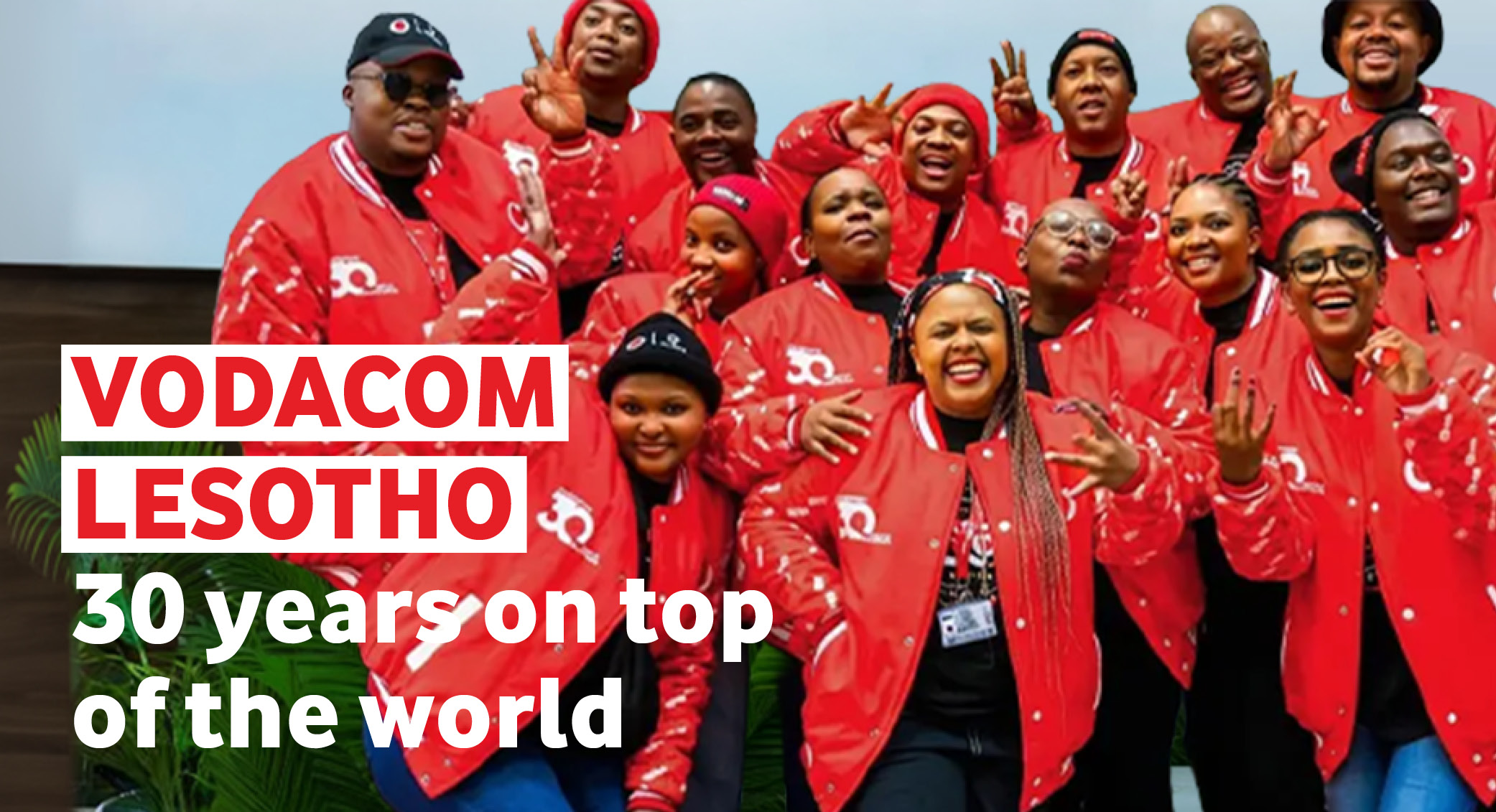
Before the public anniversary celebrations, Vodacom Lesotho colleagues had their own moment. A staff kick-off at Vodacom Park in Maseru brought teams together with departmental stalls, performances and branded apparel. There was also a surprise R300 mobile-money drop for employees, intended to make the day feel shared and practical. It was a small gesture with a clear message: employees are the first community of the brand.
The internal campaign keeps that energy going. Anniversary trivia, weekly draws, a 30-themed grand prize and a reworked 30km Tower-to-Tower relay are all giving colleagues ways to participate beyond the big launch moments. The tone is deliberately Basotho, visible and celebratory – because this milestone belongs in offices, shops, regions and teams, not only on a stage.
For a Group that believes in connecting for a better future, together, that inside-out approach is important. Vision 2030 becomes real when employees can see their own role in it: serving customers, protecting trust, solving coverage challenges and building digital platforms that people can rely on.
Beyond connectivity
The Vodacom Lesotho Foundation adds another layer to the story. Over the years, its work has pushed beyond connectivity into education, health, inclusion and environmental initiatives, including tree planting and school-shoe programmes. These initiatives show how connectivity becomes more powerful when it is paired with care for the communities it serves.
As Lesotho also moves towards its 60th independence anniversary on 4 October 2026, the overlap gives this year extra meaning. Vodacom Lesotho’s story is woven into a national story of resilience, ambition and identity.
The next 30 years will not look like the first. Customers will expect faster, safer and more personal digital services. Businesses will rely more heavily on resilient platforms. Communities will need technology that supports inclusion, opportunity and trust. That’s why this anniversary is not only about the reach of the network, but also about the people who gave it meaning – the colleagues who built it, the customers who stayed with it and the communities that made it their own.
Thirty years on, the signal that began with one portable base station has become a shared story of Basotho moving forward together.
Bongi Mbuli, Group Executive Head: Internal Communications, Vodacom Group Sian Singh, Senior Specialist: Internal Communications, Vodacom Group Content contribution: Our thanks to the internal communications teams and representatives from the Vodacom Group of companies One Spirit is edited, designed and published on behalf of Vodacom Group by Media24 (Pty) Ltd
This communication is an internal magazine for employees of the Vodacom Group of companies that is intended solely for use by Vodacom Group employees and authorised representatives. Copyright 2026, Vodacom. All rights reserved. While all precautions have been taken to ensure accuracy of information, neither the editor, publisher nor Media24 can be held liable for any inaccuracies, injury or damage that might occur.
All content, information, artwork and opinions are Classified as C1, as per Cyber Security Restrictions.