The multiplier effect: women powering Africa’s tech future
When we invest in women in technology, the returns go far beyond the balance sheet. They show up in innovation, in leadership, in lives changed – and in Vision 2030’s ambition to see women fill half of all executive seats.
A strategy, not a gesture
International Women’s Day, celebrated on 8 March, is a moment for reflection. But at Vodacom, it’s also a reminder that the most meaningful commitments aren’t made once a year – they’re built into how the organisation works every day.
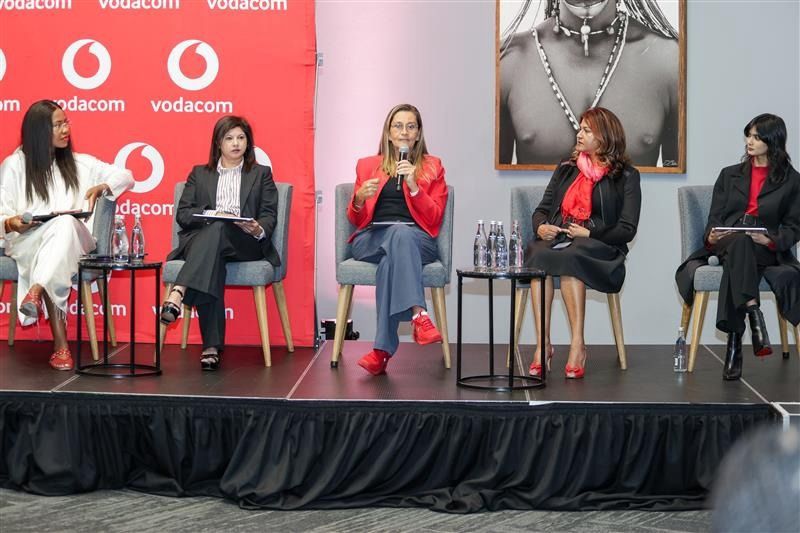
This year, we marked the occasion with a range of events and dialogues across our markets that reminded us why International Women’s Day matters: it is a call to action to elevate women’s voices, drive meaningful change and build a more equitable digital future across the continent.
The philosophy is straightforward: when organisations invest time, opportunity, mentorship, access and genuine support, they gain back in talent, perspective and growth. When women thrive, so does everyone around them.
At Vodacom, that equation is embedded in programmes, career pathways and community initiatives that are actively reshaping who gets to participate in Africa’s technology story – and on what terms.
A career path built for technical minds
For too long, the unspoken rule in technology was that career progression meant moving into management. The deeper your technical expertise grew, the more pressure there was to trade it in for a people-management role – or risk being overlooked.
Our Technical Career Path (TCP) was built to change that. Launched across Vodafone in 2023, TCP is a seven-level framework that gives technical specialists a formal, rewarded route to progress as experts – without ever having to leave the work they love. From entry-level practitioners through to senior fellows who shape Vodafone’s technology strategy, TCP makes technical mastery a destination in its own right.
For women in technology, that shift matters. Structured recognition of technical depth – through peer reviews, panel assessments, verifiable digital skills badges, monthly cash allowances and access to exclusive industry conferences – removes the informal gatekeeping that has historically slowed women’s advancement in tech. When the pathway is clear and the criteria are objective, the playing field levels.
Continuous journey of growth
“By empowering others, we build trust, we increase our team capabilities, and create a culture where people can feel valued and motivated,” says Noha Magdy-Ismail, a Technical Career Path (TCP) level 4 expert in Technology Voice in Egypt.
Accredited experts at TCP Levels 4 and above join the Vodafone Tech Expert Community, where they mentor colleagues, contribute to the company’s technology roadmap and, at the most senior levels, engage directly with Dejan Kastelic, our Chief Technology Officer, the Senior Leadership Team and the Executive Committee.
“And TCP is not a finish line,” says Dejan. “It is the start of a continuous journey of learning, growth, and technical leadership.
“It builds the engineering depth that strengthens our competitiveness, creates role models for the next generation, and helps us shape the culture we want, one where women are not just part of the conversation, but central to defining the future of technology.”
The global cost of excluding women from tech
Where gender equality has been prioritised, it has propelled societies and economies forward, the United Nations reports in its Gender Snapshot 2025. Targeted investments in gender equality have the power to transform entire societies and economies – and the data shows exactly how much. Closing the gender digital divide alone could benefit 343.5 million women and girls worldwide, lift 30 million out of poverty by 2050, and generate an estimated $1.5 trillion boost to global GDP by 2030.
“Young women in technology, don’t wait to be perfect – just be curious, be consistent, and go deep,” says Marwa Ghareeb, a TCP level 4 expert in the Infrastructure domain in Egypt.
From the classroom to the boardroom
TCP sits within a broader commitment that runs through Vision 2030’s Talent & Culture pillar: building a Vodacom where 50% of executives are women and where the talent pipeline reflects the continent we serve. That target requires deliberate action at every stage of the pipeline, from first job to senior leadership.
One of those deliberate actions is Code Like a Girl. The programme equips girls and women with coding skills and a route into STEM careers, operating across South Africa, Lesotho, Mozambique, Egypt, Tanzania, the Democratic Republic of Congo and, through Vodacom Congo, into Burkina Faso. The results are already tangible.
Vision 2030 sets an even bolder ambition: scaling Code Like a Girl to one million young people. That’s a talent pipeline for the continent’s digital economy, built one line of code at a time.
Then there’s Pouko Pouko in Mozambique, a device-financing initiative that prioritises women aged 18 to 45, particularly entrepreneurs in SMMEs and the informal sector. Since its launch in October 2023, more than 146 000 devices have been sold, with 31% of beneficiaries being women. Half of those who opened savings accounts through the programme are women – because access to a smartphone is also access to financial services, to market information and to economic agency.
How Africa is leading the way
Globally, women make up only 28% of STEM careers and hold just 26–27% of technology-related jobs – a figure that has barely moved in recent years despite growing demand for digital skills.
But Africa shows what’s possible when we widen the path. Our continent reported the highest share of women STEM graduates in the world in 2025 at 47%, outpacing Europe, Asia and North America. And while women globally hold around 28% of tech roles, in sub-Saharan Africa women hold 23–30% of tech jobs, slightly above the world average. Yet the gap remains widest at senior levels: fewer than 12% of leadership roles in African tech are held by women, reflecting a global pattern where opportunities remain in development and building the pathways to leadership for young talent.
“Giving does not result in a loss or decrease of anything. It really does become a catalyst for multiplication, growth and abundance,” says Philile Nkosi, a TCP level 5 expert in the Cloud and Infrastructure domain within Vodacom Group.
One woman at a time, across eight markets
What happens when organisations stop treating women’s advancement as a social obligation and start treating it as a strategic priority?
Our answer, played out across markets and programmes, is consistent. When you offer women a structured career pathway, they become the architects of the technology that serves millions. When you provide girls with access to coding skills, one of them ends up leading the organisation that taught her. When you give women in the informal economy access to a device and a data connection, they open savings accounts, take out insurance and build businesses.
That is what the Talent & Culture pillar of Vision 2030 looks like in practice – not a target on a page, but a multiplier effect, one woman at a time, across eight markets and counting. The investment is real. So are the returns.
Bongi Mbuli, Group Executive Head: Internal Communications, Vodacom Group Sian Singh, Senior Specialist: Internal Communications, Vodacom Group Content contribution: Our thanks to the internal communications teams and representatives from the Vodacom Group of companies One Spirit is edited, designed and published on behalf of Vodacom Group by Media24 (Pty) Ltd
This communication is an internal magazine for employees of the Vodacom Group of companies that is intended solely for use by Vodacom Group employees and authorised representatives. Copyright 2026, Vodacom. All rights reserved. While all precautions have been taken to ensure accuracy of information, neither the editor, publisher nor Media24 can be held liable for any inaccuracies, injury or damage that might occur.
All content, information, artwork and opinions are Classified as C1, as per Cyber Security Restrictions.