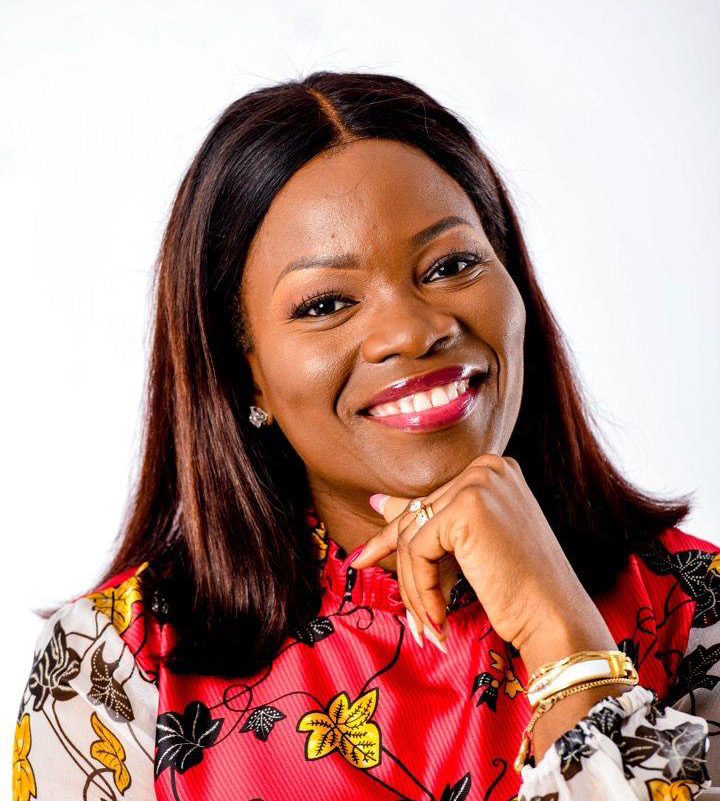
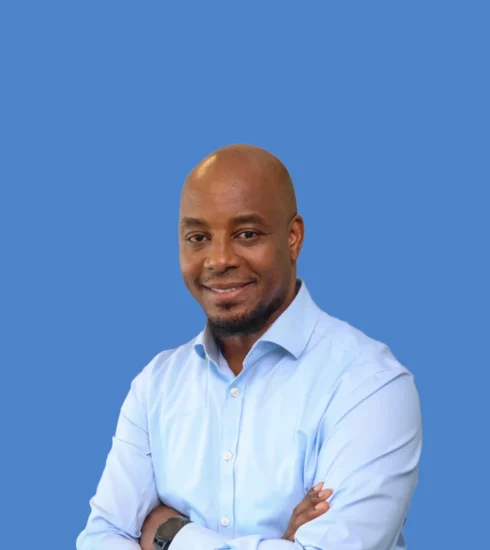
Pamela Ilunga: paving the way for tomorrow’s female leaders
Meet the trailblazing Deputy CEO of Vodacom Congo who shattered the glass ceiling while staying authentically herself. From championing women in STEM to driving digital transformation across the DRC, Pamela Ilunga reveals how authentic leadership, strategic mentorship and unwavering love for her country fuel her mission to connect Africa for a better future.
Carrying a sense of responsibility
ONE SPIRIT: You made history as the first woman to hold the Deputy CEO position at Vodacom Congo. What went through your mind when you accepted this role, and how did it feel to break that barrier for future generations of women?
PAMELA: “My very first feeling was one of extreme gratitude towards the Creator, Madame Chair and the rest of the Board – followed quickly by anxiety about the work and expectations. Breaking a barrier always carries a sense of responsibility unlike any other. I reached out to one of my mentors, who told me to simply stay authentic. I reached this position as myself, and I did not need to become anyone else.”
You’ve mentioned that leadership isn’t about titles but about “moments” – those instances where we can truly impact others. Can you share a specific moment in your career where you felt you made a real difference, and what that taught you about authentic leadership?
“I can share two examples. One was when I was Human Resources Director (HRD) at G4S, the security services company. One day, after I had left the company, I bumped into a former employee at an embassy. He explained to me and my children how I stood up for him in a meeting, and he never forgot it. I had completely forgotten the incident, but it stayed with him for many years afterwards.
“Another was a text I received from a Vodacom employee. He simply wanted to say hi and felt compelled to tell me how deeply touched he was that when he was sick with COVID, I would call him every day until he tested negative (this was when I was HRD). He told me that when I heard his father had passed, I had sent him the first message of condolences. I was already Deputy CEO by then. He was touched that I would text him words of encouragement and prayers.
“I had forgotten these two events, but neither of them had.”
Personal journey and values
Your LinkedIn posts reveal a deep commitment to work-life integration rather than work-life balance. As a family woman and demanding executive, what systems and mindset shifts have enabled you to thrive in both roles – and what would you tell other working mothers struggling with this challenge?
“This is the hardest one. I am not and never will be the mom who is available to go on the school field trips. But having said that, I am a fully hands-on wife and mother – from managing lunch menus to attending my husband’s work events and managing emails late at night after bedtime (especially when they were younger).
“There’s one key thing that helps me integrate my two worlds: a supportive partner and grandmothers who live close by and who believe in my dreams and are always ready to step up and step in when I cannot.
“We are incredibly lucky to be in a company that provides the flexibility that allows me to leave early for an award event at school and come back to the office afterwards.”
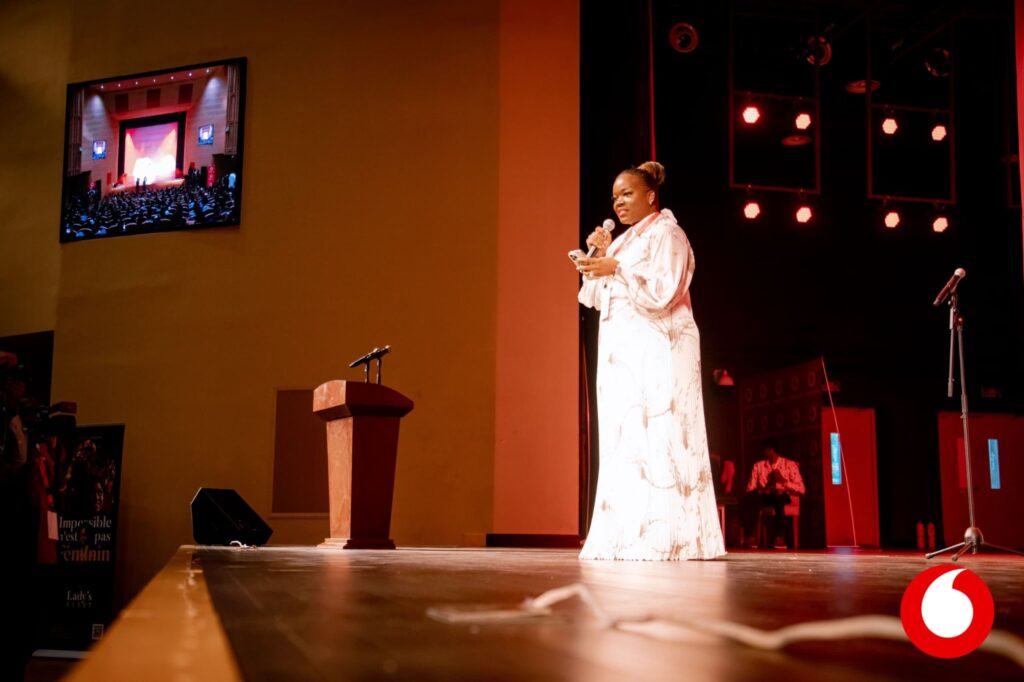
Earlier this year, Pamela was invited to speak at the first edition of TEDxKinshasaWomen, a unique event celebrating women’s exceptional contributions to society.
You credit women mentors who believed in you and modelled balanced leadership. Who was that pivotal person who first saw potential in you, and how do you now “pay it forward” as a mentor yourself?
“Viviane Bakayoko, former CEO of Citibank DRC. Viviane is a wife and mother of three. She saw my potential and hired me knowing I was four months pregnant with my second child in 2014. Remote working was completely unheard of in the DRC in the pre-COVID era – and even more unheard of was hiring a pregnant woman.
“I try every day to pay it forward by helping women navigate the challenges of work-life integration or balance in the traditional context we live in.”
Bringing DRC to the world of technology
Your love for the DRC shines through everything you do. Having witnessed both its challenges and potential first-hand, what drives your commitment to uplifting your country through technology and connectivity?
“I have had the opportunity to visit and live in quite a few countries in the world, and I always say that the DRC is the only place in the world where my language is understood, my identity is not questioned, and no matter where I go, there is a pulse and beat that soothes my soul.”
“I love this country with every fibre of my being. That is exactly what drives me to bring this country to the big and beautiful world of technology, because it’s one of the best and fastest ways to sustainable development.”
Women in technology and unconscious bias
The Code Like a Girl programme is inspiring young women to enter STEM fields. But beyond inspiring them to start, what systemic changes do you think we need to help them stay and thrive in technology careers, especially when they face unconscious bias later on?
“It would have to be societal. This idea that only men understand maths and science is the biggest myth that persists here. We need to change it one tiny village at a time.”
When you look at Vision 2030 and imagine Vodacom’s future across Africa, what excites you most about the possibilities?
“The most exciting part for me is that these are highly achievable targets and the fact that we can be a part of making this happen! This is life-changing and industry-changing for our country and for the continent.”
Personal resilience and growth
Your transformative experience at Harvard Business School clearly impacted your leadership approach. What was the most surprising thing you learnt about yourself during that programme, and how has it changed the way you lead at Vodacom Congo?
“Aside from the obvious business management and global economic subjects, on a more personal level, what Harvard taught me the most is that I do not have to carry all of the world’s problems. That I could let go. I could upskill and trust my teams to step up. That listening is more powerful than always talking. I have learnt that we are all teachable at all levels and by all people.”
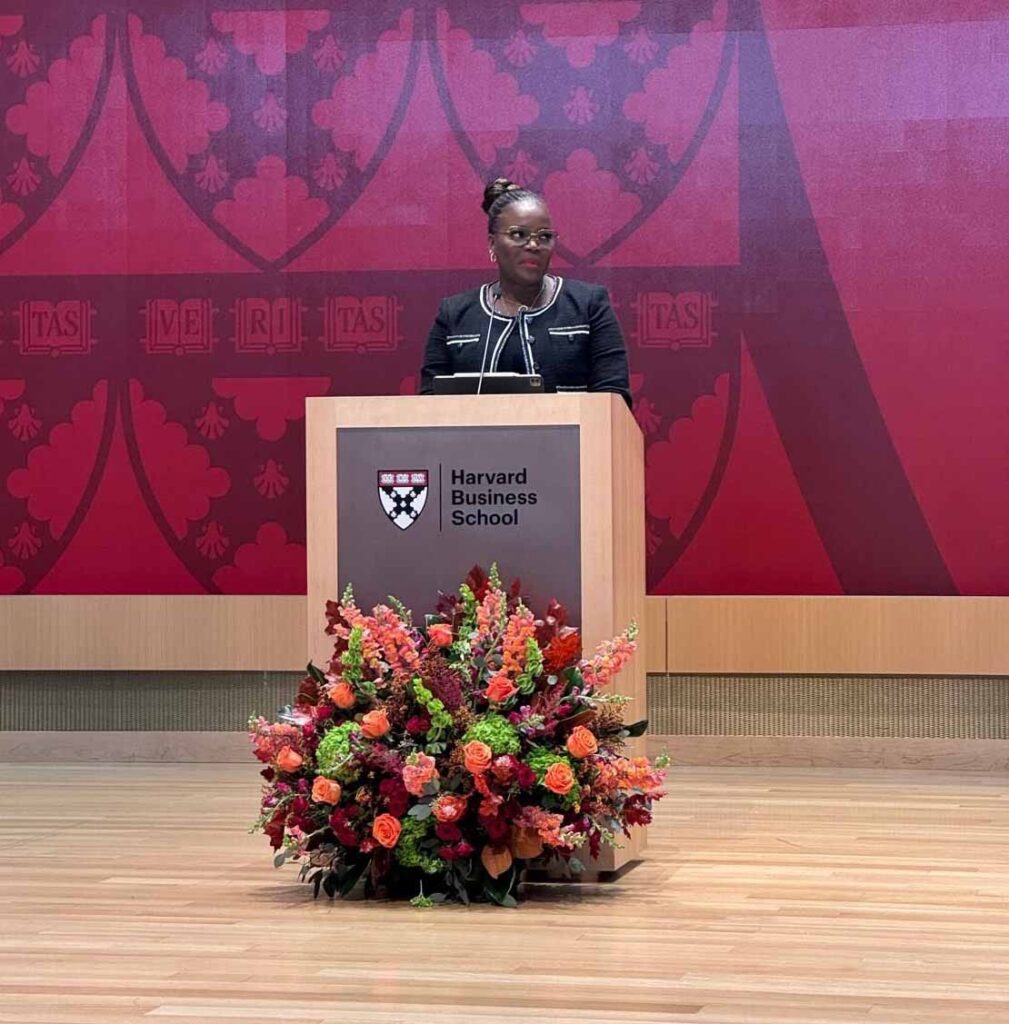
Pamela’s classmates in the Advanced Management Program at Harvard Business School chose her to represent them as class co-speaker at the graduation ceremony on 15 November 2024.
Having worked across South Africa, Gabon and the DRC, you’ve seen different African markets and business cultures. What unique strengths does each market bring, and how has this continental perspective shaped your understanding of what “connecting Africa” really means?
“I always say, Africa is not a country! What worked in Gabon might not work in the DRC and vice versa, even though they’re both francophone countries. It removed my bias and the idea of ‘knowing’ a country before you have set foot in it.
“More importantly, context gives more meaning. Being in a country, understanding the culture, the challenges, gives far deeper insight than any spreadsheet or PowerPoint can.
“However, taking the learning from one market to another can be helpful in management, as long as the customisation is relevant for that specific market.”
Leaving a legacy
Beyond business metrics and technical achievements, when you think about the legacy you want to leave – both as a leader and as a woman who opened doors for others? What impact do you most hope to have made?
“At the end of it all, I would like to be remembered as someone who was firm but fair. Someone who was honest and always led with integrity. Someone who listened to people. Someone who was not afraid to say no in a room full of yes. Someone who spoke truth to power. Someone who opened doors for others. Someone who trained and pushed people to excel and grow outside their comfort zone.”
Bongi Mbuli, Group Executive Head: Internal Communications, Vodacom Group Sian Singh, Senior Specialist: Internal Communications, Vodacom Group Content contribution: Our thanks to the internal communications teams and representatives from the Vodacom Group of companies One Spirit is edited, designed and published on behalf of Vodacom Group by Media24 (Pty) Ltd
This communication is an internal magazine for employees of the Vodacom Group of companies that is intended solely for use by Vodacom Group employees and authorised representatives. Copyright 2026, Vodacom. All rights reserved. While all precautions have been taken to ensure accuracy of information, neither the editor, publisher nor Media24 can be held liable for any inaccuracies, injury or damage that might occur.
All content, information, artwork and opinions are Classified as C1, as per Cyber Security Restrictions.