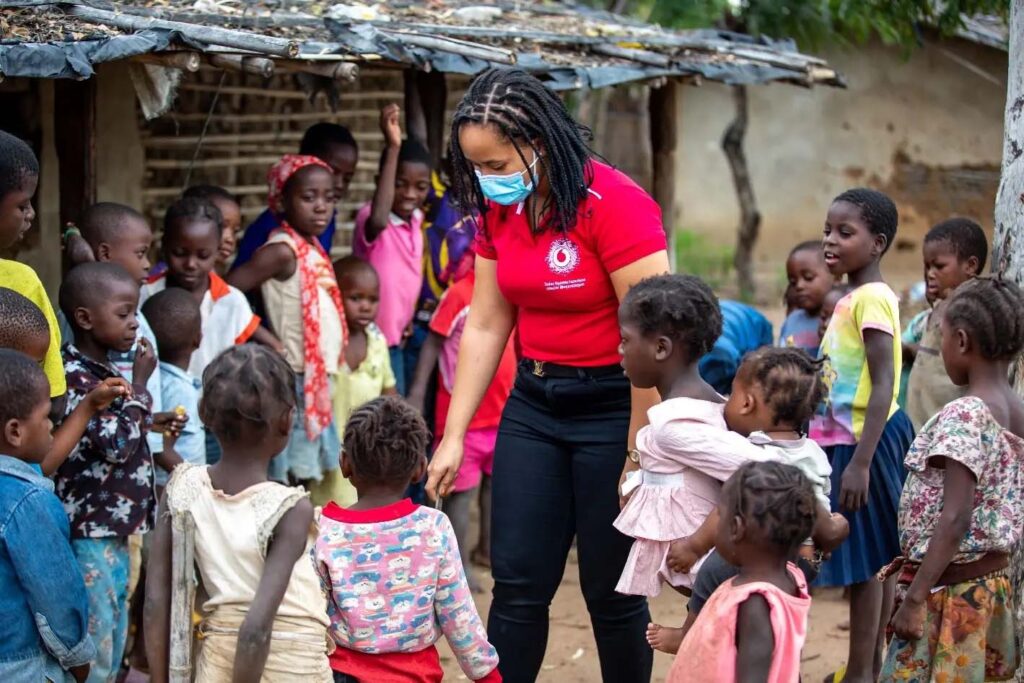
Meet Vodacom Mozambique’s Daisy Jardim, a pioneering volunteer whose passion for technology and education is reshaping communities. Celebrated for her impactful work in Foundation programmes, Daisy’s story is one of passion and empowerment.
More than a decade ago, Daisy was struck by lightning. While the experience was, understandably, traumatic, it served as a catalyst for her future and inspired her to study electrical engineering. It was around the same time that Vodafone Foundation, in partnership with the United Nations High Commissioner for Refugees (UNHCR), launched Instant Network Schools.
Today, in a world where technology is the gateway to endless possibilities, Daisy is a powerful advocate for digital empowerment through Instant Network Schools. Her commitment earned her the accolade of Vodafone Foundation’s Volunteer of the Year, marking her as a leader in its mission to leverage technology for societal good.
Passion for progress
Daisy’s volunteering journey began in 2018 with Code Like a Girl, the programme designed to inspire girls to explore the world of science, technology, engineering and mathematics (STEM). She soon developed into a trainer and project coordinator. Under Daisy’s guidance, more than 2 000 young girls have now learnt how to code, ready to redefine gender roles in technology.
In 2021, Daisy joined Instant Network Schools, launching the first classrooms in Nampula Secondary School and Maratane Refugee Camp in Mozambique.
Daisy uses her technical know-how and skills to help these refugee communities use technology to transform learning. Her team of three also trained coaches and teachers to set up various digital resources, provide guidance on using the tools and technologies, and effectively run the classrooms.
She returned to the Instant Network Schools programme in 2022 to launch 10 more schools in the city of Nampula and upgrade existing schools. The next time Daisy joined it was as a team leader, and she helped upgrade 15 schools, launched a further 11 schools, and assessed the struggles faced by the users and coaches of the programme.
Doing important work
It was the students’ reaction that made Daisy realise the importance of the work they are doing. “When we give a tablet to a child in a bigger city, they’ll browse for games or search for their favourite football players on Google,” she says. “But in these schools, the first thing the children do when they are given a tablet is do their homework or look for information related to what they are learning at school.”
Because of her experiences as a volunteer, she believes that technology can transform our understanding of what education is and it should inform what education can be.
“This work gives me the opportunity to work with people of so many different backgrounds and cultures,” Daisy says. “I have learnt so much from them and love that I get to share my knowledge with others in return.”
Bongi Mbuli, Group Executive Head: Internal Communications, Vodacom Group Sian Singh, Senior Specialist: Internal Communications, Vodacom Group Content contribution: Our thanks to the internal communications teams and representatives from the Vodacom Group of companies One Spirit is edited, designed and published on behalf of Vodacom Group by Media24 (Pty) Ltd
This communication is an internal magazine for employees of the Vodacom Group of companies that is intended solely for use by Vodacom Group employees and authorised representatives. Copyright 2026, Vodacom. All rights reserved. While all precautions have been taken to ensure accuracy of information, neither the editor, publisher nor Media24 can be held liable for any inaccuracies, injury or damage that might occur.
All content, information, artwork and opinions are Classified as C1, as per Cyber Security Restrictions.